
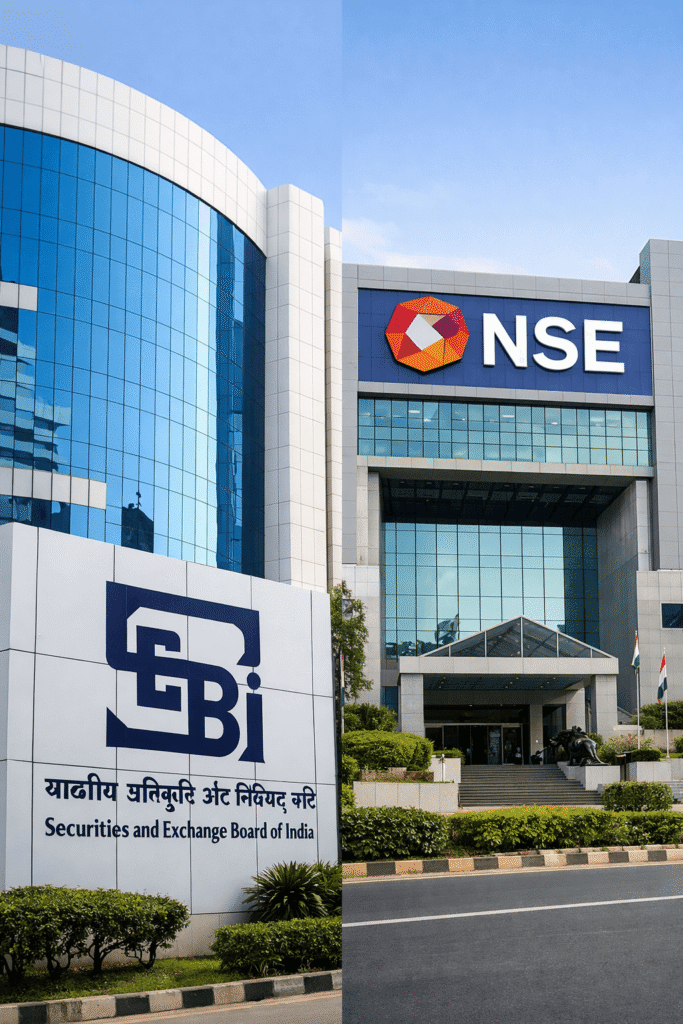
As a response to the SEBI’s February 2025 directive to regulate retail participation in algorithmic
trading (algo trading), the National Stock Exchange (NSE) has recently published (May, 5, 2025)
detailed implementation standards aimed at making algo trading both accessible and secure for retail
investors.
A quick recap of the SEBI February Directive, which forms the regulatory foundation for NSE’s
implementation standards, targeting fair and secure retail algo access:
SEBI Regulations (Effective August 2025)
SEBI’s new guidelines for algo trading introduce major changes to protect retail investors while
ensuring transparency and accountability.
| New Rule | Description |
| Mandatory Exchange Approval | Brokers must get each algo strategy approved before offering it to retail traders |
| Unique Identifier for Algo Orders | Every algo order must carry a unique tag for tracking and audit purposes |
| Registration of Algo Providers | Only exchange empanelled algo providers can be onboarded to offer services to retail traders |
| Order Rate Limits for Retail Traders | Retail traders must register their algorithm if it executes more than a set number of orders per second |
| Two-Factor Authentication (2FA) for APIs | Strong authentication mechanisms to prevent unauthorized API-based algo trading |
| Brokers Responsible for Complaints | Brokers must address issues and complaints related to algo trading |
| Categorization of Algos | Algos will be classified as: ● “White box” (where logic is disclosed and replicable) ● “Black Box” (where the logic is not known to the user and is not replicable – proprietary strategies) |
Why SEBI introduced the Rules:
- Prevent market manipulation
- Ensure fair access to retail investors.
- Increase transparency with unique IDs and exchange approval.
- Enhance security with API authentication preventing unauthorized trades.
- Protect investor interests
Now let us discuss the recently published NSE Rules:
Key Highlights of the New NSE Standards: Explained for Retail Traders
- Static IP Address for API Access
When the retail investor or the client connects to the stock exchange through an API, the broker needs
to make sure that the connection is secure and trustworthy. In the past, there were concerns about
unauthorised access or malicious trading. To prevent this, the new guidelines require traders to connect
through a static IP address—essentially a fixed, identifiable address used to access the internet.
This means, if the client wants to use algo trading, client must provide her broker with a static IP address.
If client wants to change the IP, she can only do so once a week (unless there’s an urgent reason). This
makes sure there’s no unauthorised access to the trading system. There is a provision of defining
secondary IPs also & IPs at API key level too. - Threshold Orders Per Second (TOPS)
The Threshold Order Per Second (TOPS) is initially set to not exceed 10 orders per second and may be
adjusted by the stock exchanges as needed after due notice to the market.
If client is placing fewer than 10 orders per second via the API, there is no need to formally register her
algorithm with the exchange. This makes it easier for basic traders, who don’t use very high-speed
trading systems, to implement automated strategies without jumping through too many regulatory
hoops. If client exceeds this limit, she will need to register her algorithm with the exchange and get an
official algorithm ID. - Role of Brokers and Algo Providers
Brokers can create different algorithms for their clients, and each one is documented with a specific ID
for the exchange. The broker is able to present these algorithms to clients, supplying the pertinent
information regarding the algorithm to those utilizing it. All client orders carried out using these
algorithms must incorporate the correct exchange algorithm ID. If any changes are made to a broker’s
algorithm, the broker will inform the exchange and update the necessary approvals.
While, all algorithm providers must register with exchanges in accordance with the guidelines set by
each exchange. Each algo must be registered with the exchange, which will assign a unique ID to each
one. Brokers can make commercial agreements with algo providers, including sharing fees, and can
also set up technical arrangements through the algo provider’s technology services.
- Enhanced Risk Management & Security
The new standards place a strong emphasis on security and risk management. Every time a client uses
her trading algorithm, the system must be secure. Trades will be logged (recorded), and every order
placed by the client must be verified with two-factor authentication (2FA). This ensures that only
authorised users can trade and that y trades are properly recorded for future review. - Tagging and Audit Trails
Each order client places through an algorithm will have a unique tag or ID attached to it, provided by
the exchange. This is like a serial number for every order, making it easy to track back and verify who
made the trade, when it was made, and how it was executed.
Conclusion
The NSE’s implementation of SEBI’s vision is a landmark moment in Indian capital markets. It bridges
the gap between tech-savvy retail investors and professional-level automation, without compromising
on market integrity. As algo trading becomes more inclusive and regulated, retail investors stand to gain
both in performance and protection.
References
- NSE Circular – Safer Participation of Retail Investors in Algorithmic Trading
Issued by the National Stock Exchange of India Limited (Ref. No: NSE/INVG/67858, dated May 5,
2025).
2. SEBI Circular -Regulatory Framework For Algo Trading
SEBI/HO/MIRSD/MIRSD-PoD/P/2025/0000013, dated february 4,2025